Menu

Plymouth & District Archaeological Society

Search the PDAS site

Home.
Notice Board.
Archaeology Lectures.
Archaeology Field Trips.
Archaeology Workshops.
Practical Archaeology.
Calendar.
Membership.
PDAS Committee.
Winter Lecture Reports.
Field Trip Reports.
Workshop Reports.
Photo Gallery.
Contact Us.
Useful Links.
Site Map.

Archaeology

Lectures

Winter lectures are held on Monday evenings at 7:00 pm in the Devonport Lecture Theatre of the Portland Square Building, Plymouth University. Non-members are welcome to attend all lectures but are asked to contribute £4 towards our expenses.

5th October 2009

THE SILCHESTER ROMAN TOWN LIFE PROJECT

Prof Mike Fulford

Mike Fulford is Professor of Archaeology at the University of Reading where he has research interests in Roman archaeology, particularly of urbanism, economy and trade. This lecture will outline the main results of the continuing excavation (now in its 13th year) to explore a large residential block (insula) of the Iron age and Roman town of Calleva Atrebatum (Silchester) from its origins in the late Iron Age to its demise between the 5th and the 7th century AD.

----------------------------------------------------

2nd November 2009

DEFENDING THE ISLES OF SCILLY

Mark Bowden

Mark Bowden is a Senior Archaeological Investigator for English Heritage.  He has undertaken a number of research projects in the north of England but now works in the West Midlands and the South-West. This project grew out of concern over the loss of parts of the historic fabric of St Mary’s Garrison to accelerating coastal erosion and resulted in a detailed survey of the Garrison Walls and Civil War defences and some small-scale excavations. This has now been developed into a multi-disciplinary research programme looking at all aspects of the military defences of the islands.

----------------------------------------------------

7th December 2009

NEW PERSPECTIVES ON SILBURY HILL

David Field

David Field is an Archaeological Investigator for English Heritage where he specialises in the study of ancient landscapes, in particular, of the Neolithic and Bronze Age periods. This lecture will describe the history of excavations at the site including the extraordinary work that has recently taken place in response to the hole that appeared in the summit in the year 2000 and he will place the site in its contemporary context and describe subsequent developments at and around the site.

----------------------------------------------------

1st February 2010

THE 8,OOO YEAR SUBMERGED LANDS OF THE SOLENT

Gary Momber

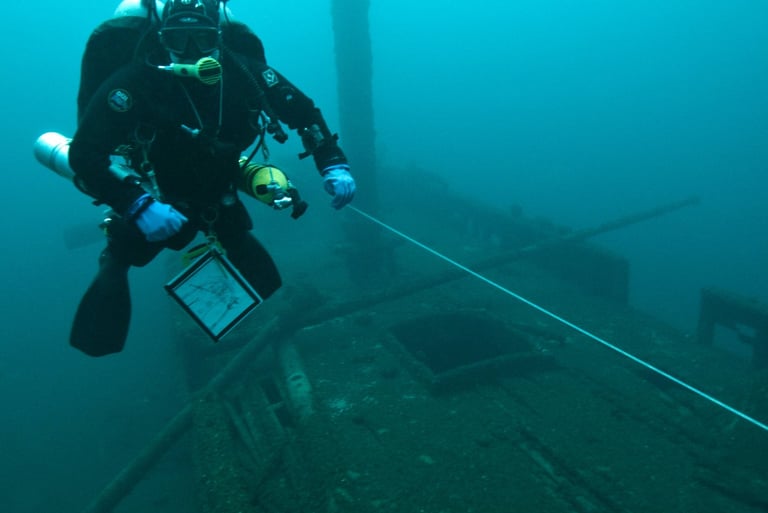
Garry Momber is the Director of the Hampshire and Wight Trust for Maritime Archaeology and a Research Fellow in the University of York. The discovery of submerged occupation sites in a drowned forest 11m below the Solent, showed the potential of the seabed to preserve archaeological and palaeo-environmental material. Excavation has revealed a landscape over 8,000 years old containing locations with different functions including the oldest boat building site in the world complete with remnants of a log boat. To understand these sites there is a need to interpret climatic changes and adaptations brought about by coastal geomorphological processes. The lecture will look at the artefacts discovered, reconstruct events that resulted in flooding of the landscape and look at the potential for similar sites.

----------------------------------------------------

1st March 2010

THE HUMAN OCCUPATION OF THE BRITISH ISLES

THE CHANNEL RIVER AND SOUTHWEST ENGLAND

Prof Tony Brown

Professor Brown works in the School of Geography at the University of Southampton where his research interests cover floodplain & alluvial geomorphology, palynology and human environmental relationships and changes - much of which is of direct relevance to archaeology. Research funded by the Aggregates Levy has greatly helped our understanding about the evolution of the Straights of Dover, the Channel & Solent Rivers and the creation of Island GB. His lecture will look at the Palaeolithic occupation of the UK with special reference to South West Britain.

----------------------------------------------------


29th March 2010

FRAGMENTATION OF THE BODY

Comestibles, compost, or customary rite?

Prof Chris Knüsel & Dr Alan Outram


Christopher Knüsel is Associate Professor in Bioarchaeology and Dr. Alan Outram is Head of the Department of Archaeology, University of Exeter. In cases where human remains have become heavily fragmented and mixed with apparently similarly fragmented animal remains, interpretations could range widely from suspected cases of cannibalism, through to unusual or non-normative burial, to post-depositional disturbance and natural processes. Robust protocols are essential in order to assess and interpret such assemblages, as well as to begin to comprehend their cultural, social, and political significance. This lecture examines an example of this approach applied to the Late Bronze Age site of Velim Skalka, Czech Republic.


(This lecture was originally scheduled for 12th April but has been rescheduled due to

a change in the commitments of one of the speakers)


More information .....


-----------------------------------------------------


Winter Lecture Season 2009-2010

CHANGE OF DATE

CHANGE OF DATE